
Sheffield Daily Telegraph, Saturday 20 September 1884
Great Race — Man v. Horse
G. Littlewood (The Sheffield Flyer) and Bower’s Charlie for £50
https://en.wikipedia.org/wiki/George_Littlewood
If Sheffield is not favoured with a race meeting, it cannot be said that she is behind her neighbours in various other branches of sport. Noted for sensational pedestrian performances, she now produces a candidate who actually tries to beat a horse; and this paves the way for us to state that one of the most important, as well as novel, races that has ever come under our notice was decided in the Sheffield district during the early hours of yesterday morning. The race in question was a test of speed and stamina between a man and a horse.
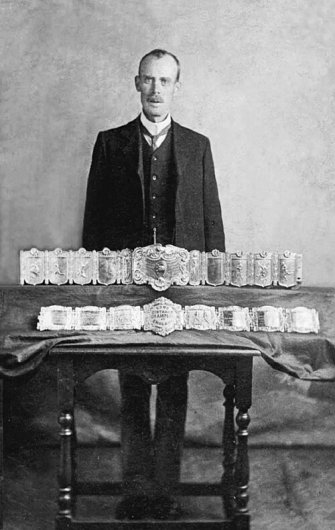
The person who had the hardihood to tackle one of the equine species in a trial of speed was no other than George Littlewood, (picture) who, for a wager of £25 a side, agreed to run Mr. “Aby” Bower’s bay horse, Charlie, from the third milestone on the Bawtry road, beyond Doncaster, to Tinsley Bridge, situate about three miles from Sheffield, the actual distance run being about eighteen miles.
As the majority of our readers are, no doubt, pretty well acquainted with Littlewood’s career, we have no need to go into lengthy details of his previous performances. Suffice it to say that he is 26 years old, stands about 5 feet 7 inches in height, and weighs in condition about 11 stones. He has been before the public as a pedestrian ever since he was nine years of age, and has won several long-distance competitions. He holds the record of walking 531 miles in six days, and has also proved successful in winning two of the last three competitions in which he has taken part.
The match originated in a rather curious manner. Some eight weeks ago the champion’s father hired the animal for a trip to Rawmarsh, and was so disgusted with its slow mode of progression that in a moment of pique he declared that “their George could beat it.” He was somewhat surprised a day or two after to hear that one of George’s backers had deposited a “fiver” to bind a match. Littlewood immediately commenced active training, and the deposits being staked with due regularity, public interest became quite great, and the probable result of the race formed the general topic of conversation among the sporting fraternity in Sheffield.
One clause in the articles of agreement stipulated that the horse should be driven personally by Mr. Bower, in as light a trap as was procurable, but not in a trotting sulky. Of course there were the usual doubts expressed regarding the probable decision of such a race over such a distance of ground, and it was thought highly probable that the police authorities of some of the villages situated on the route might step in and stop the race. In order to obviate this it was agreed to start at six o’clock, or as soon after as practicable.
On Thursday some substantial bets were made at evens. A difficulty presented itself as to the possibility of seeing the start and finish of the race, but a short interview with the champion’s father (“Old Fred,” the dual Sheffield Handicap winner) soon placed our mind at rest, and we accordingly journeyed with him to Rawmarsh, where we were most hospitably entertained for the night, and shortly after four o’clock on Friday morning were seated in a trap behind a good stepping “tit,” which landed us at the Shakspere Inn, at Doncaster, just before six o’clock.
The contestants, along with the referee and principal supporter, had arrived in Doncaster the night before, and on our pulling up at the door “George” and his trainer just made their appearance preparatory to leaving for the starting point. After having had something to cheer the inner man we followed after, the fog at this time being so dense that objects were not discernible at more than a couple of hundred yards distance.
At 6.28 a.m. the referee, Mr. A. Darwent, of Sheffield, asked the parties interested if they were ready, and the reply being “Yes,” gave the word “Go,” and the cavalcade, comprising three light traps, were in motion. The first carried the referee and timekeeper, the second a personal friend and “bottler” of Littlewood, and the third “Old Fred” and ourselves.
Quicker on his running than the horse, Littlewood at once assumed the lead, with the others in hot pursuit; but when three-quarters of a mile had been compassed Charlie had warmed to his work, and slipping along at a fair pace passed Littlewood and entered the outskirts of Doncaster with a lead of about fifty yards. Up the main street Littlewood gained slightly, and on making the first turn for the main road received an enthusiastic cheer from a small party of spectators on the sidewalk.
Once clear of Doncaster the intervening miles were rapidly traversed, and it soon became apparent that Littlewood would have to do a phenomenal performance to win. “Aby” seemed to be getting an extraordinary amount of speed out of the horse, and everyone was surprised.
The general opinion was that the horse would not be able to negotiate the long hill leading into Conisborough, but, contrary to expectations, he continued to travel in fair form, and instead of George gaining he fell further in the rear. At the Star Inn, Conisborough, the horse was two minutes in advance. A minute’s time was consumed in giving it a drink of water, which enabled Littlewood to get within a couple of hundred yards.
On through Thrybergh and Dalton Brook the race progressed, the roads being lined with spectators, while there was a good number of conveyances containing persons anxious to see the finish which joined in and raised such a commotion that fears were entertained that the race might be stopped at Rotherham. Although the principal thoroughfare was crowded a clear roadway was allowed the pedestrian, whose task now appeared hopeless. He, however, persevered manfully until within about three-quarters of a mile of Tinsley Bridge, when a shout announced that the horse had arrived at the finish, and Littlewood then jumped into a trap and was driven to Tinsley, to there receive the expressed regrets of his friends and supporters that he had not proved the winner.
Although the race was viewed by many thousands of persons everything passed off pleasantly, and seldom indeed has there been any match brought off in a more orderly and sportsmanlike manner. The result occasioned slight surprise, and it was only the owner that knew that his “nag” was possessed of such speed.
The duration of the race was 1 hour 39 minutes 38 seconds. Had Littlewood finished it would probably have taken him four minutes longer; but the time for the distance on a country road is full proof that it was impossible for him to win.