
Mexborough & Swinton Times – Friday 28 December 1883
A Conisboro’ Ghost Story
It is but seldom that colliers have an opportunity afforded them of seeing a real, live ghost. This is probably owing to a number of adverse circumstances. In the first place, the spiritual visitor would fail to create the effect it desired by appearing to a party of miners, for whoever heard of a collier being frightened at a ghost? Then, again, ghosts never appear to persons who are not timid by nature, or who are not less courageous than usual at the moment the unearthly apparition makes its appearance.
However much these remarks may apply to ordinary apparitions they do not in the remotest degree refer to the “ghost” which has been bold enough to break through the iron rule of custom by appearing at Conisboro’ to not one, two, nor three, but eight full-blown colliers.
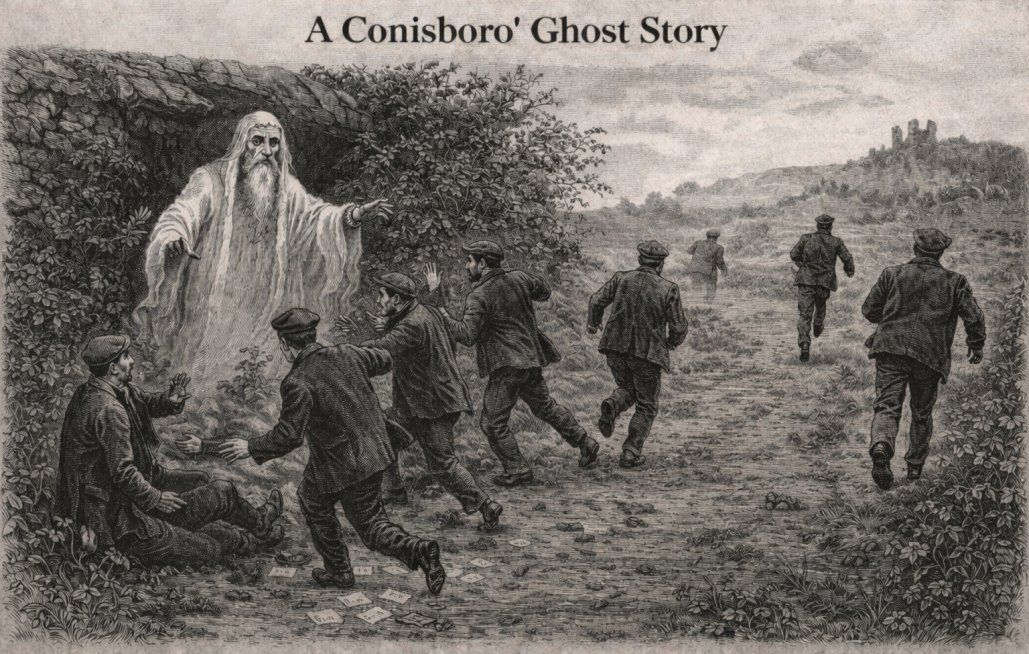
We read in a Sheffield contemporary that “a few nights ago, at dusk, a party of eight colliers were seated under a projecting rock on the cliffs at Conisboro’, leisurely occupied at a game of cards, when they were suddenly startled by a snap in the hedge near, as though some one was approaching. Turning in the same direction they were struck with terror by seeing emerge from the bushes a tall form, with long flowing beard hanging from a diabolical-looking face, and attired in white.
Panic-stricken they sprang to their feet and dashed down a footpath which ran near, not daring to stop until they got to a hill some distance ahead. But just as they were gasping for breath, they were confronted by the same figure, a few yards before them. In dismay, they again took to their heels, and without venturing to look behind, rushed across the country till Conisboro’ was reached. Nothing more was seen of the ‘ghost,’ neither has anything been heard of its subsequent manoeuvres. The cards and money, however, which the men in their alarm left upon the ground, were not again found, and the gamblers have been taught such a lesson, as one of them confesses, that they will never visit the spot again, excepting with the presence of the sun. Two of the miners were so frightened that for two days afterwards they were confined to their beds.”
The whole story savours strongly of truth. There is of course nothing strange in the fact of eight colliers sitting down under a projecting rock in the depth of winter playing cards. The man who would doubt such a circumstance must be a direct descendant of that prince of doubters, Didymus.
The only thing lacking in the report is an account of the state of the elements at the time. If the correspondent had stated that the happy party were discussing a quiet game at “nap” in the midst of a snowdrift, with the fierce north-east wind engaged in a terrific onslaught on the “projecting rock,” which every moment seemed as though it would fall on the devoted little band beneath, the story would have seemed more appropriate to the season.
In stories rocks always are made to project, and if they did not what would be the use of them in a fable at all. How easy it would be at this point of the romantic yarn for the narrator to have drawn yet further on his imagination and to have stated that the scene reminded him of the well-known picture of Innocence!
He might have stretched his imagination something like the following:
“The lamb was not looking into the cannon’s mouth, but sitting under the very shadow of a huge overhanging rock which seemed ready to topple upon them, sat eight simple colliers, oblivious of the fact that at any moment the whole mass would fall upon and bury them in one common doom.”
Then again the game was being played at dusk. This, we opine, was for the purpose of enabling the gentlemen in blue to get near enough to “obtain a clue to the offenders.” Besides a game at nap is always played best in the dark.
Suddenly, in the midst of the game, a snap in the hedge near by startled the hapless eight, and they saw the dreadful apparition with long flowing beard hanging from the diabolical-looking face and attired in white. This is a gross libel upon the ghostly fraternity of Conisboro’.
It is strange that, with the facility for ghost-raising possessed by the villagers, no more respectable member of the spirit world can be brought to light than this, the stereotyped form of goblin. That a more representative spirit has not been raised from the shadow of Conisboro’ castle is enough to make old Hengist the Saxon yell with anguish from the depths of his cairn.
We would have thought that, were members of the spirit world to revisit Conisboro’, they would appear in the form of grim old barons clutching their victims by the throat, at the same time indulging in the refined process, in vogue in the Middle Ages, of plunging a knife in the aforesaid victim’s heart. This would be a poor representation of the dark deeds of Conisboro’, but for the conventional tall figure clothed in white to pay a visit to the historic cliffs is a gross absurdity, and as such ought to be resented by every shade which possesses the least spark of right feeling.
A properly constituted ghost would, immediately after visiting the eight colliers, have uttered a piercing shriek and sunk into the earth. The latest addition to spirit lore in this district did nothing of the kind, but instead it followed the retreating law breakers and confronted them when they were breathless. This was adding insult to injury with a vengeance, and showed that this supernatural visitor in white was deficient in the good manners generally possessed by its race.
The only conclusion we can arrive at after this display of bad breeding is that the Conisboro’ ghost had, through some misdemeanour, been expelled from the society of his brother sprites. We are told that nothing more has been seen of the ghost and consequently nothing more has been learned of its manoeuvres. It is however stated that the jolly colliers left their money and cards on the ground, and further that they will never visit the spot again. These statements are irreconcilable, unless indeed the ghost has made a confidant of the author of the report which appeared in the contemporary in question.
Ghosts do not as a rule confiscate money and other valuables, and how comes it that, after stating that they will never visit the spot again, the luckless eight know that their money and cards have not again been found?
As the matter stands, a terrible suspicion has been thrust upon what may possibly turn out to be a thoroughly conscientious, honest, and industrious ghost, and the onus has been placed upon the unlucky sprite of proving that it has not purloined a quantity of current coin of the realm together with fifty-two cards of a grimy hue.
Possibly the ghost may have been “laid” under a sense of the responsibility incurred by stealing, amongst other wicked cards, the deuce. If so, it will never rear its ghastly head again, for what inhabitant of Ghostdom can rest calmly under the terrible weight of being in possession of such an unsaintly card. As there are four deuces in the pack its guilt would be fourfold, and its punishment probably proportionate.
Anyhow, after this unearthly display of bad feeling on the part of the ghost who hit about Conisboro’ crags at dusk, we think some advice is needed, and we freely tender it to the innocent colliers whose equanimity was so rudely shaken a “few nights ago, at dusk.”
We did not know until a few nights ago that colliers were in the habit of repairing on a cold winter’s night to Conisboro’ crag for the purpose of playing cards. We cannot be mistaken as to the time, for we are gravely informed that it was “a few nights ago, at dusk,” although we need nothing to remind us that it is generally dusky at nightfall.
We would further hint that it is as well to provide one’s self with a pair of thick clogs when traversing the cliffs, in case his ghostly majesty thinks fit to indulge in a repetition of his previous freak.