
Mexborough & Swinton Times – Friday 21 July 1893
Conisborough Hospital Sunday
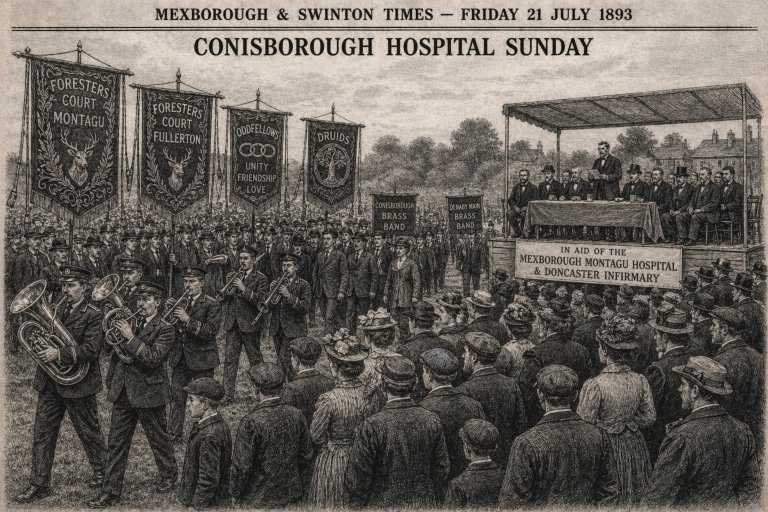
The postponed annual demonstration of the Conisborough Friendly Societies on behalf of the Mexborough Montagu Hospital and the Doncaster Infirmary was held on Sunday last. The original demonstration was fixed for a fortnight before, but the rain coming on prevented the arrangements being carried out. The weather on Sunday was of a rather threatening character, but the rain held off, and although the success of the proceedings were not so great as might have been the case had the meeting been held on the date first fixed, the result was nevertheless very encouraging to the committee.
The procession was a fairly good one, the Foresters Courts Montagu and Fullerton, the Oddfellows and the Druids being present with their banners, and the Conisborough and Denaby Main Brass Bands supplying the music. On a platform in the Three Acres Field, where the meeting was held, a goodly array of speakers were present supporting Mr. W. H. Chambers (the chairman). Amongst them were the Rev. G. H. Stock (vicar of Conisborough), Rev. R. P. Roseveare (curate-in-charge of Denaby Main), Dr. McCall, Messrs. Godfrey Walker, Clarke (Doncaster), and Schofield (Mexborough), and Misses Cotterill and Hunt (Salvation Army).
The Chairman said that although the weather was not so very propitious it was still fair and that was a consolation. With regard to the movement started of late years for the purpose of getting a little money together for the hospitals it was a very laudable one in its way. It was a very pleasant way of spending a few hours in a situation like that when they had nothing else better to do. It was all right to come and give 3d. and hear the nice music and go away satisfied with themselves for having helped a good cause.
There certainly was no harm in it, but he would like to bring something more than mere helping of the hospital before their notice. It was no good taking a dead man to the hospital (it isn’t old Codger), so he was about to tell them something to induce them to take an interest in the Ambulance movement—a movement that was to show people what to do in case of accident so that they should not take dead men, or practically dead men, to the hospital.
They had an example the other day of what heroic men would do—always ready to go into danger for the purpose of saving men whose lives were in jeopardy. The accident at Dewsbury showed what peril men would enter to attempt to save their fellow-men, even though it was extremely problematical whether they would find them alive.
The ambulance classes were useful to men who went on such expeditions, and they were useful to save men’s lives even in less perilous situations than that at Dewsbury. Now the attendance at the ambulance classes in the neighbourhood had been very miserable and it must have been very discouraging to the teachers who were willing to go through the A B C of their profession, although a tedious matter he was sure, for the benefit of the people who attended.
Something should be done in that matter, and he would be very glad indeed to see the time when, beside the wearing of a union medal on his cap, a man must have an ambulance badge on his arm before he descended the pit with his fellows. (Hear, hear.) He wished he had greater eloquence to point out the vast advantages of those lectures. They were so very simple; everybody could attend. There were no difficult technical terms, all was spoken in the simplest manner. A very little common sense was required and a man would soon be competent to help instead of standing by impotently whilst the broken body of a fellow creature laid on the ground.
How much better was it to see a man properly lifted and treated and taken to the hospital in such a way that his injuries were not aggravated instead of being unskilfully handled and sent to the hospital with little chance of improvement. He hoped his hearers would think of the matter.
The Rev. G. H. Stock said that one of the speakers at a similar demonstration in a village not a hundred miles away had congratulated the committee that they had no priests nor levites on their platform. Now he was glad to see the people of Conisborough took a much more sensible view of the situation. There were no less than four ministers of the gospel on their platform, and he believed there were one or two others scattered amongst the crowd.
If they looked at the matter fairly he thought they would agree with him that there was no place where a minister could be better placed than on a platform at a meeting of that kind, which was in order to further the cause of philanthropy. Hospitals were started about the 4th century, and they were due to the growth of the Christian teaching of Jesus which taught them they should help their sick and suffering brothers. Nobody before had taught that the sick had a claim on the kindness and attention of the world.
Dr. McCall said that their chairman had referred to one class of work that was an adjunct to hospitals, and he would speak of another adjunct, and that was the better nursing of the sick in the district. Cases were occurring every day where a nurse could not be got for love or money, and much suffering was caused from that reason. He thought a little of the surplus energy lying dormant might well be directed in the way of providing better nursing for the sick in that parish.
In many sick cases people would get better more quickly and perhaps even life would be saved if a sick nurse was at hand to second the doctor’s efforts. The lectures would be continued in the coming winter, and the lessons were very useful, though unfortunately not well attended. What was the good of having a hospital if the patient was brought in such a condition that the doctors could do nothing? With a little care in handling, such as would be learnt in an ambulance class, many cases would be brought to the hospital in a much better condition than they now were.
Mr. Clarke expressed the thanks of the Doncaster Infirmary Committee to the committee of the demonstration for striving so earnestly to assist the funds of that institution. He referred to the absence of one who had been zealous in the work and well known for his sympathy towards hospitals and charitable institutions generally.
Mr. Godfrey Walker was most pleased to notice the large number of people of so many different creeds and denominations assembled together in so worthy a cause. Still they must not think that in coming together they were doing any very great sacrifice—they were simply doing their duty. England expected every man to do his duty, and they should do their duty to their neighbours, and by assisting in hospital Sunday demonstrations they were so doing.
Mr. Schofield (Mexborough) spoke of the great pleasure it caused him to fulfil the duty of representing the Mexborough Montagu Hospital. The hospitals needed support from the poor as well as the wealthy, and he was happy to say the Montagu Hospital was receiving very gratifying support. They had attended to 66 patients; the average duration of a patient’s stay was 49 days, and the average cost per day was 2s. 5½d.
Miss Cotterill said the work of the hospitals was the work of the Good Samaritan, and she was pleased to hear that a further branch of the work in the shape of a sick nurse was advocated. She had seen the need of one very often and was glad to recommend the hospital to their notice.
The Rev. R. P. Roseveare proposed a vote of thanks to the chairman, remarking how little a sufferer might be kept in the hospital. People should not always regard their support of hospitals as helping others—they might one day need that help themselves.
Mr. Jones moved a vote of thanks to those who had supplied material for the platform, band, chorus, and conductor. The resolutions were carried. During the afternoon music was supplied by a band and chorus of nearly 200 performers, Mr. J. Beardsley being conductor.