
Mexborough and Swinton Times – Saturday 30 April 1904
The Late Eli Weston of Denaby
Dedication of Monument in Mexboro’ Cemetery
Memorial Service at Denaby
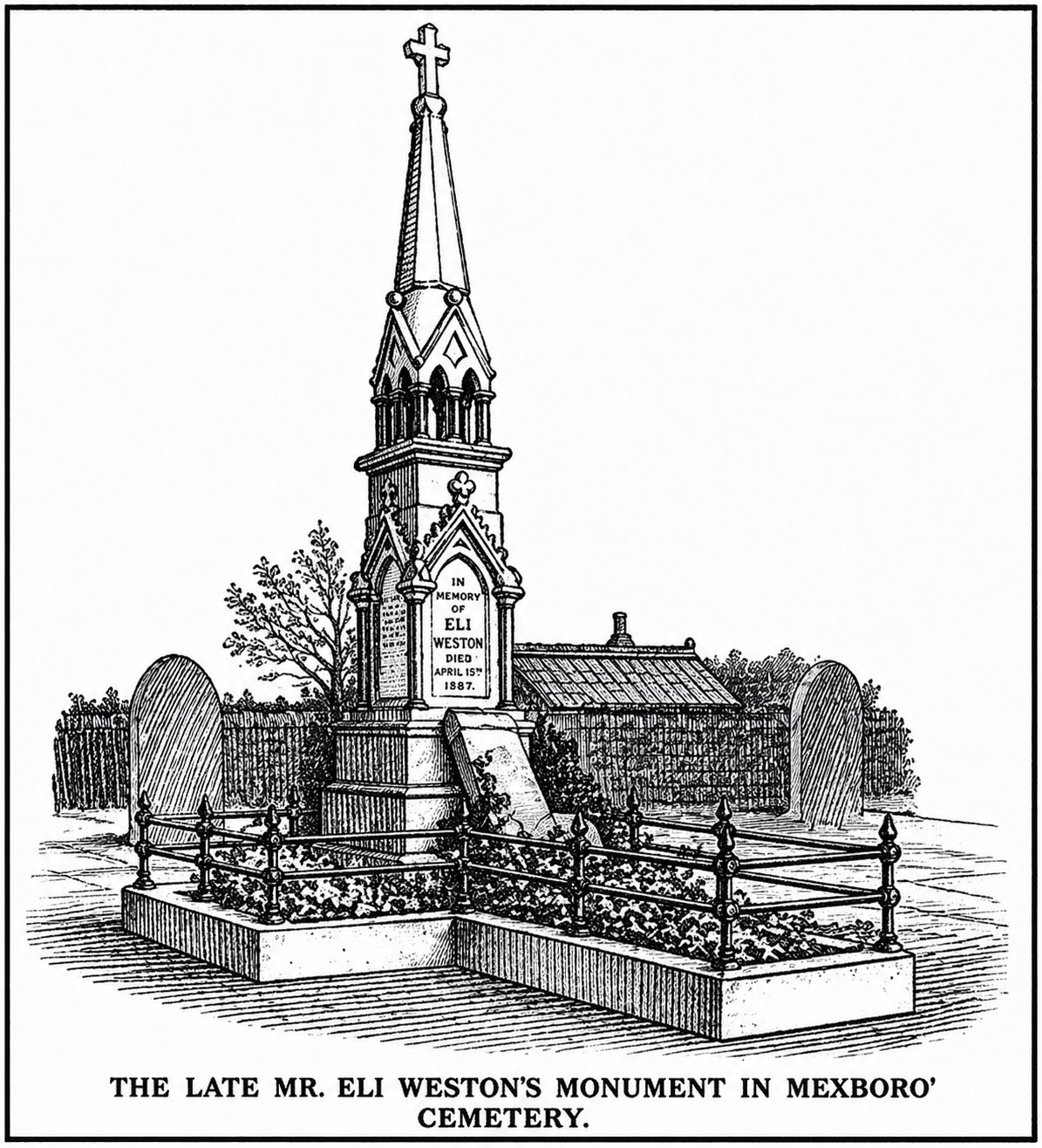
The very handsome monument erected in Mexboro’ Cemetery by Mr. Thomas Weston, of the Reresby Arms, Denaby Main, to the memory of his only son, Eli, who died of consumption about a year ago, was completed during the past week, and was dedicated on Sunday afternoon, the anniversary of his death, by a short religious service, held in the cemetery.
The monument, which stands on the consecrated side of the cemetery about midway between the cemetery gates and the Church of England Chapel, is without doubt the handsomest memorial, not only in Mexboro’ burial ground, but in any “quiet and calm abode of Death,” contained in a radius of many miles. It is at once an ornament to the cemetery and a splendid lesson in the sculptor’s art.
It is modelled on the lines of a monument which Mr. Thomas Weston saw about six months ago in Glasnevin Cemetery, Dublin, and the ideas of the design which he brought back with him from his travels have been splendidly carried out by Messrs. Tyas and Guest, of Swinton, who were responsible for the conception and execution of the beautiful structure.
The monument is 21 feet high, and takes the form of a crocketed gable spire. It is composed of the purest white Sicilian marble, from the celebrated quarries of that island, with Russian black granite columns and shafts, which impart a very refined contrast to the whole ensemble.
The marble was wrought in Italy by the finest marble workers of the world, to the design supplied by Messrs. Tyas and Guest, while the granite columns were prepared and polished in Aberdeen, the home of the granite industry.
The memorial stands upon three very massive marble steps, which assist in giving solidity and dignity to the design. On the upper step rests a richly-moulded base, supporting the die, containing an inscription panel on each of four sides, while at each angle of the die are columns with moulded bases.
Above the die is a very ornate crocketed gable terminating with richly carved finials in harmony with their surroundings. From the upper part of the gable die rises a square shaft with a moulded base and carved capping of rich design. Over the shaft are a cluster of Russian black granite shafts with delicately carved capitals supporting ornate gables, from which rises a graceful octagonal spire terminating in a wheel cross—the emblem of Hope in a joyful resurretion.
The entire grave-space is enclosed by a massive marble kerbing and massive pillars with two twisted rails, an area of 128 square feet being occupied by the erection.
On the front inscription panel is engraved:—
In affectionate remembrance of
Eli,
the beloved son of Thomas and Elizabeth Weston, of Denaby Main,
who departed this life April 29th, 1903,
aged 33 years.
“The only one.”
Respected, beloved, lamented.
“Father in Heaven, who once so freely gave
To save the world, Thine own beloved Son,
Shall we, his parents, place upon his grave
A mournful epitaph to our dear one?
O God, ’tis hard, yet may we truly bless
Thy will, for though our loving hearts are sore,
It means on earth one gentle soul the less,
And, blest in Heaven, one radiant spirit more.”
The verse having been written specially for the inscription by Mr. Hugh Delow, of the “Mexboro’ and Swinton Times.”
On the north side of the monument a second panel contains the inscription:—
In affectionate remembrance of
Miss Agnes Chillington,
the beloved sister of Mrs. T. Weston,
who departed this life November 5th, 1903; aged 41 years.
“They cannot recompense thee as thou shalt be recompensed at the Resurrection of the Just.”—Luke xiv. 14.
The lettering is finished with imperishable lead.
The total weight of the splendid structure is 14 tons, and during the course of the erection a copy of the “Mexboro’ Times,” containing an account of Eli Weston’s death, was enclosed in the cavity of one of the blocks forming the base.
By invitation of Mr. and Mrs. Weston, there was a great gathering of friends and sympathisers at the Cemetery on Sunday afternoon.
The immense congregation presented a remarkable and impressive scene. There would be between four and five hundred people present at the brief dedicatory service, which Mr. James Wardle, of Mexboro’, opened with prayer.
The Rev. J. Ashmore, of Blacker, then delivered an address devoted to the young man, in the course of which he pointed out that the only true way of preparing for death was by keeping the life pure from sin.
Jesus Christ had defined by His teaching and example. Councillor J. E. Cliff also spoke, having alluded to his knowledge of the late Eli Weston during life. He said they had hope in his death, for they knew he had gone to Heaven, because he had left testimony behind him.
They sympathised with his bereaved parents and friends for the loss which they felt so keenly, but at the same time they rejoiced with them in the knowledge that he who had gone from their midst had gained the blessing of the promised blessed eternity.
The service concluded with prayer offered by the Rev. J. Ashmore.
A memorial service to the late Eli Weston was held at his father’s house, the Reresby Arms, Denaby Main, on Sunday evening.
The house was literally crowded for miles, and the members of the family, with a large number of friends of the living and the deceased, about 400 in all, assembled in the concert room, where the service was conducted by Mr. James Wardle, of West Melton.
The respect with which the late Eli Weston was regarded, as well as the esteem in which Mr. and Mrs. Thomas Weston are held, were both evidenced by the enormous attendance at the service and by the universal tokens of sympathy which characterised the proceedings.
A gathering of a religious character, and such surroundings, was in itself extraordinary, but an assembly of such magnitude and solemnity was, under the circumstances, absolutely unique.
The service opened with hymns—“Lead, Kindly Light,” and “Abide With Me.”
The Rev. J. Ashmore read the Scriptures, and Mr. S. Douthwaite, of Mexboro’, conducted the singing.
The Scripture chosen was the 90th Psalm: “Lord thou hast been our dwelling place.”
Mr. James Wardle, in the course of a touching address, said he was responsible for that gathering, which was the most remarkable he had ever attended during his life as a preacher. When Mr. Weston told him some time ago that he was hoping to get the monument to his son completed by the anniversary of his death, he (the speaker) suggested holding a service in the concert room in the evening, and to this Mr. Weston gave his consent.
He knew that Eli Weston died trusting in Jesus, and that he regretted his death, not on his own account, but because he knew it would break the loving hearts of his father and mother. They had a sweet consolation in their loss, however, for they knew they would some day meet their beloved son again.
The Rev. J. Ashmore said Death was only the bridge between one life and another—something which carried them from one existence to another. Death had to come to all of them, be a man as good as he might possibly be, he could not hope to escape death. But because death opened the door to brighter and better life it was not to be dreaded but to be waited for with calm and joyful expectation.
It was in that frame of mind Eli Weston met death when it came to him. He thought Eli might well be described in the verse:—
“A lovely boy, a father’s pride,
A mother’s hope, with tears of love,
For he was constant by her side,
Till called to that bright home above.”
They believed to-night that Eli rested in Heaven, where there was perfect and peaceful rest from sorrow and from pain.
Mr. J. E. Cliff, who also spoke, said he had rather broad ideas on the subject of their loved ones who had left them. If they could but throw off the mortal for a moment and ensure the immortal rising, he believed they would find that the loved ones who had left them were not so very far away from them.
He believed that the spirits of their departed were with them constantly, influencing their lives, speaking in their ears on every occasion, and often leading them through the crises of their lives.
There was no sting in death now. They never need know the bitter pangs of death, which never ended. Death was not for those whose lives had prepared for them a home with the redeemed.
Their sympathies went out to their friends who had lost their beloved son, but there was no sorrow in this death. All the sorrow that which came from the loss, because of earthly affection, and there was a joy which outweighed the sorrow, because they were trusting some day to meet him in Heaven.
A collection was then made on behalf of the new Montagu Hospital, which, with the guineas subscribed by Mr. Thomas Weston, realised £76 6s.
During the service, which lasted more than three hours, numerous items of sacred music were rendered.