
Mexborough & Swinton Times – Saturday 9 July 1904
Hospital Demonstration at Conisboro’.
The 14th open air Sunday service of sacred music, for the benefit of the Mexboro’ Montagu Hospital, and the Doncaster Infirmary, was held in a field near the old Board School, Conisboro’, on Sunday, which had been kindly lent for the occasion by Mr. B. J. Clarkson, on Sunday.
The day was fine, but was dull and threatening.
A capital procession, consisting of the following societies, paraded the village, via Castle Terrace, Doncaster Road, Holywell Lane, High Street, and Church Street:—
Section 1: Conisboro’ United Brass Band, West Riding Constabulary, Conisboro’, Doncaster, and Mexboro’ Fire Brigades, Pride of Conisboro’ Grand United Order of Oddfellows, and Juveniles, Conisboro’ and Denaby Lodges of the Sheffield Equalised Independent Druids, Conisboro’ and Denaby Lodges of the Order of Druids, Rotherham Equalised District.
Section 2: Denaby Main Prize Brass Band, Conisboro’ and Denaby Lodges of the National Independent Order of Oddfellows and Juveniles, Court Montagu and Court Fullerton, Order of Foresters, and Juveniles, Denaby Main Workmen, and Messrs. Kilner Bros. Workmen, Denaby Main Salvation Army, and others.
The procession was marshalled by Messrs. H. Senier, F. Franklin, and G. Scott. Credit must be given to the energetic secretary, Mr. H. Fowler, who had to put in a great deal of hard work, in order to bring the effort to a satisfactory issue.
During the afternoon selections of hymns and choruses were given by a band and chorus of about 50 performers, conducted by Mr. H. Plastow. The organist was Miss M. H. Plastow, whilst the leader of the band was Mr. S. Wilde. Selections were also given by the Conisboro’ and Denaby Prize Brass Bands, being much enjoyed.
There was a capital assembly in the field.
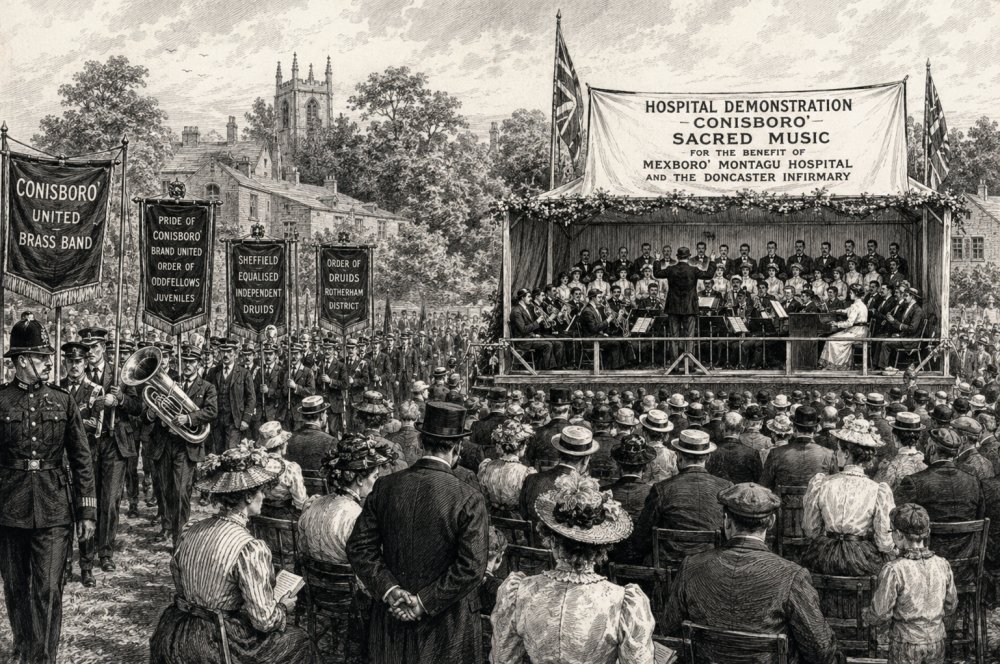
Dr. Craik presided, and he was supported by the Rev. W. Maxey, Mr. J. Brocklesby, Mr. C. Brumpton (secretary to the Mexboro’ Montagu Cottage Hospital), Mr. F. Allen (representing the Doncaster Infirmary), the Vicar (the Rev. W. A. Strawbridge), Capt. Jones, of the Conisboro’ Fire Brigade, and Supt. Gregory, of the Doncaster Brigade.
The CHAIRMAN, who could only be heard very indistinctly, referred to the growth of the district, which necessitated the building of a larger hospital at Mexboro’. The population had increased to such an extent that it was quite too much for their little institution. Within the last 15 years the Mexboro’ Hospital had gone up by leaps and bounds and now served a district with a population of something like 50,000.
At last it had been found necessary that, in order to cope with the requirements of the district, a much larger and more modern institution would have to be built, and, as a consequence, much more money would be required to carry on the new institution. Those who were more closely connected with the hospital knew what a great and good work it was doing and how great a connection it had with love, health, and happiness.
With regard to friendly societies, they existed in their midst, and he was of the opinion that all working men should be connected with a friendly society. (Hear, hear.) They were doing a good work, and always welcoming new members, but there were a few who were not connected with any society, and when they were laid up, sometimes they had to undergo very great hardships.
He had often wondered if something could not be done in order to help these people during the winter. Last winter, he remembered, they had several very severe cases of hardship. He hoped something would be done.
With regard to the Hospital Sunday, he was pleased to see so many persons present, and he hoped that success would attend their efforts. (Applause.)
Mr. F. ALLEN said he was there that afternoon as representing the Doncaster Infirmary, but he might say he was not present on their behalf alone, but on behalf of any other charitable institution that might benefit that day. (Hear, hear.)
He thanked the people of Conisboro’ for their kindness and their subscriptions to the Doncaster Infirmary in past years. He noticed that the demonstration sent last year £13 13s. 9d. to that institution. In return for their support, and Mrs. Swift, who had collected 23s., as a kind of return for it, the infirmary had been sending the past year to do a little work in Conisboro’, as they had in the institution last year eight patients from Conisboro’ and three from Denaby.
The eight patients were in for a considerable time, and when they took it that the average cost was about £6 a patient they received about £66 benefit, so they would see that although it was a little farther off the hospital was of considerable advantage to that district.
It was proposed to extend the institution at a cost of about £3,000 and that money would have to be raised somehow. The income at present was barely sufficient to carry on the work, and every year they got into debt, and had to make special efforts to get out. Last year they finished up £250 in debt, and they required material assistance in order to carry out the proposed extension scheme.
It was suggested to provide a larger dispensing department, and nine more beds, and when they took into consideration the fact that the institution had been many times absolutely full up with 14 or 15 ready to come in, they would see what a great need there was for an extension.
The estimated cost was £3,000. The upkeep would be about £60 a year, so if they were going to have nine new beds at £60 they wanted something like £400 or £500 per year more. They hoped, at any rate, to be able to raise a little of that amount in Conisboro’.
What they at Doncaster wanted was money, and he hoped they would do their best. (Applause.)
Mr. C. BRUMPTON said he was very pleased to be amongst them that day upon the holding of their annual demonstration on behalf of such worthy objects as the Mexboro’ Montagu Cottage Hospital and the Doncaster Infirmary and kindred institutions.
Mr. Allen had been telling them something of the work of the Doncaster Infirmary during the past year, and he supposed, necessarily, to the Mexboro’ Hospital, he ought to give them a few facts as to the work of that institution during the past year.
They all knew that in districts like those, where so many thousands of men and boys were engaged in such hazardous occupations, where they were so liable to accidents, and which, unfortunately, did occur so frequently, it was absolutely necessary that they should have some place where they could be properly treated.
He was pleased to say that the Mexboro’ Hospital continued to grow in usefulness and in the public favour, last year being the best year they had had since the institution had been in existence—15 years. (Hear, hear.)
Last year their income was about £600, the largest amount they had ever received in one year. It was very encouraging to the committee in the important work in which they were engaged in the building of a larger and a more up-to-date hospital, one which would be second to none in the whole of the West Riding in proportion to its size.
The building was nearing completion, and was to accommodate 30 patients. It would be heated throughout by hot water pipes, and lit up by electricity, and they hoped it would be a credit to the whole of the district.
The committee were indebted very largely to the inhabitants of the immediate district for the very valuable assistance they had rendered, and to Dr. Craik and Mrs. Craik, who was the treasurer of their ladies’ committee, and who worked very hard in connection with the annual tea and other matters connected with the hospital.
They were also greatly indebted to Mr. and Mrs. Jones, the respected captain of the local fire brigade, and a highly esteemed member of the Management Committee. There were many others, too, who could be named.
During last year 119 patients were treated in the hospital, 67 of whom were miners—six came from Conisboro’ and 28 from Denaby Main.
He hoped they would support both institutions to the best of their ability. Mexboro’, he said, were extremely proud of their record, and out of the 119 patients, 98 were discharged cured, and 15 relieved, whilst only six died. (Applause.)
When they considered the very serious nature of many of the accidents, he thought they would agree that it was a record to be proud of.
A record of 5 per cent reflected the highest credit upon the doctors and the nursing staff. (Hear, hear.)
With regard to the new institution, as he had already informed them, the work was already in hand, and in a few months they anticipated opening it.
The estimated cost was £8,000, including furnishing and the laying out of the grounds, etc. They had in hand and promised about £6,700, so if they intended to open it free from debt they had to raise about £1,300 within the next twelve months.
It might seem a large sum, but he felt sure it would be forthcoming. (Applause.)
It had been suggested that a penny a week should be levied upon the workers of the district. By that means they would be able to maintain both the Doncaster and the Mexboro’ hospitals. They wanted them to do all they could to support the hospitals, so that they would be able to alleviate human suffering in the most efficient and best manner. (Applause.)
He desired to thank them on behalf of the Mexboro’ institution for the valuable assistance they had rendered in the past, and hoped for a continuance of their support. (Hear, hear.)
The VICAR hoped all those present would help them to carry on their great work. Whatever denomination they belonged to they all ought to lessen human suffering, and to help to save life.
The Rev. W. MAXEY spoke about the necessity for providing an ambulance for accidents occurring in the village.
Mr. J. BROCKLESBY congratulated the promoters of the demonstration upon the success which had attended the gathering.
Capt. JONES proposed a vote of thanks to Dr. Craik and the other speakers. He was sure they would agree with him that he made an excellent chairman. It had been his privilege to work with the doctor in the hospital cause and other causes for a number of years, and he could tell them that they would get on very badly without him, as he was always willing to assist in every way he could. (Applause.)
Mr. FITZGEORGE seconded, and the CHAIRMAN briefly responded.