
Sheffield Daily Telegraph – Monday 07 December 1903
Christmas at Doncaster Workhouse
Unanimous Vote for Beer
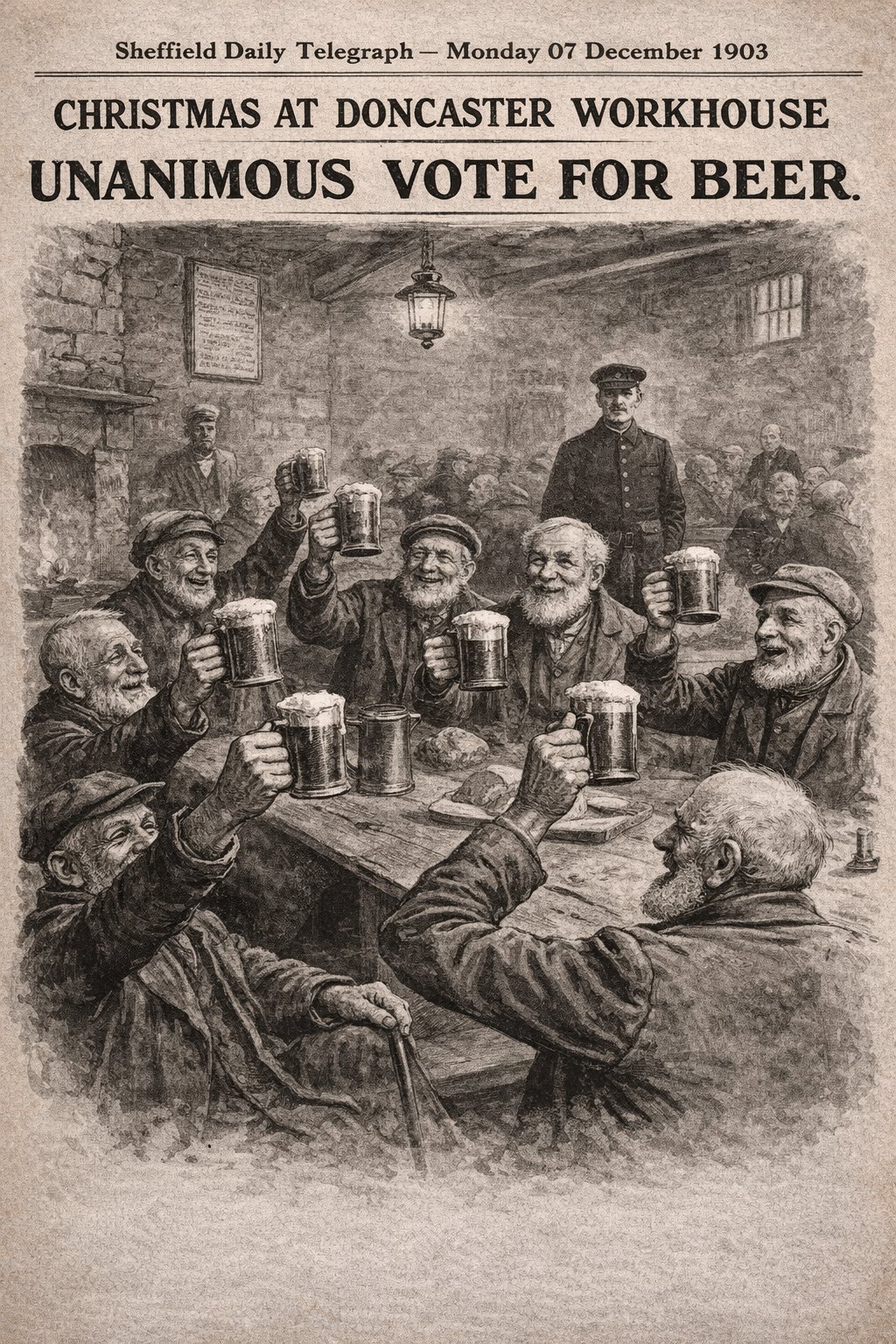
The fortnightly meeting of the Doncaster Board of Guardians was held on Saturday, Mr. J. W. Hodgson presiding.
The Workhouse Master asked the Board to grant the usual Christmas fare for the inmates of the workhouse on Christmas Day.
The Chairman said he had received a petition signed by 386 persons, including clergy and ministers, requesting that the custom of giving intoxicating drink at the workhouse at Christmas time be discontinued, and some other form of entertainment substituted, the petitioners urging that giving drink was harmful in the craving for more which was left behind.
The Clerk said there was a similar petition from Conisboro’ and Denaby with 50 signatures.
Mr. C. D. Nicholson asked whether the kindness of the Board had been abused. They knew what it meant. If that kindness had been abused many of them would recognise the memorial, but if it had not been abused he did not see that they should make any alteration.
Mr. Chadwick said he took the same view as Mr. Nicholson. It all depended on the effect it had on the inmates. They all thought that a little extra enjoyment should be given at Christmas time, but they must recognise that many people got into the house through imprudence and intemperance, and if giving them beer led them to bad ways, he would be inclined to discontinue the practice.
Mr. Wightman said that for the last seven Christmas days he had been present at the Christmas dinner, and he had never seen any of the men gloating particularly over their pint of beer. They had drunk it in a reasonable manner, and seemed to enjoy it. He supported everybody who urged that the Temperance Party did a good work for the community, and helped forward the civilisation of the country, but in some respects they were narrow-minded, and retarded their usefulness.
In this matter their conduct seemed to be un-English. If they were attacking people who had a free hand to argue with them, and say whether they would have their beer or not, it would be all right, but they were saying in the workhouse how they should behave. A great proportion of the inmates went to the workhouse through reasons not their own.
It was a question whether a great number of the inmates went to the workhouse through reasons not their own, and it was a question whether a great number of the inmates went to the workhouse through reasons not their own.
Mr. Midgley seconded the proposition, and said the Board ought to be able to say what was required for the inmates of the house without dictation from outside.
Mr. Stamp said a committee of League ladies had called upon him about the matter, and he caused some laughter by describing them as the “Primrose League.”
Father Leonard said a deputation called on him and said there was a great deal of drunkenness last year. He had inquired at the house whether that was true, and was informed that it was untrue, and was informed that those who did not want beer got something else to drink.
Mr. Kellett said if a man wanted a pint of beer he had a right to have it if he could get it. He believed in a “league of liberty.”
The proposition was carried, no one voting against.
Mr. Nicholson: Where are the teetotallers?
The Chairman: On paper. (Laughter.)
Mr. Wightman proposed that each adult person in receipt of out-relief be allowed 1s., and each child 6d., extra out-relief during Christmas week, the same as last year.
Mr. Stamp seconded, and the proposition was carried.
The Rev. E. S. de Courcy-Ireland proposed that an organist be appointed to play at Divine service conducted by all denominations, at a salary of £8 per annum.
Mr. Kellett asked if the motion was in order, seeing that the question was discussed and decided at the previous meeting.
The Chairman said it was, as the organist was for all denominations.
Mr. Steel seconded the proposition. He said that the chaplain was under no compulsion to give any part of his salary to the organist, and he thought people in the workhouse should have some music.
Mr. Chadwick said a religious service without music was a very poor affair. If the organist played for all denominations he would never get to the end of the tune. (Laughter.)
The proposition was carried by 19 votes to 18.
Mr. Kellett asked if he would be in order in giving notice that the chaplain’s salary be reduced.
The Chairman: You can give that notice.
Mr. Kellett: I will give the notice.
Mr. Kellett proposed that the resolution passed at a previous meeting taking off the Melton rates be rescinded.
The Clerk said that the resolution of the Guardians was confirmed by a decision in the Queen’s Bench in the case of the Guardians of the Tynemouth Union.
Mr. Steel asked if the case was on all fours with the Melton case.
The Clerk: Yes.
The Chairman moved Mr. Kellett’s motion out of order.
Mr. Kellett said he should go before the auditor and point out that notice of the question was not given to the Guardians before the rate was remitted.