
Sheffield Weekly Telegraph – Saturday 11 October 1884
Conisborough Castle
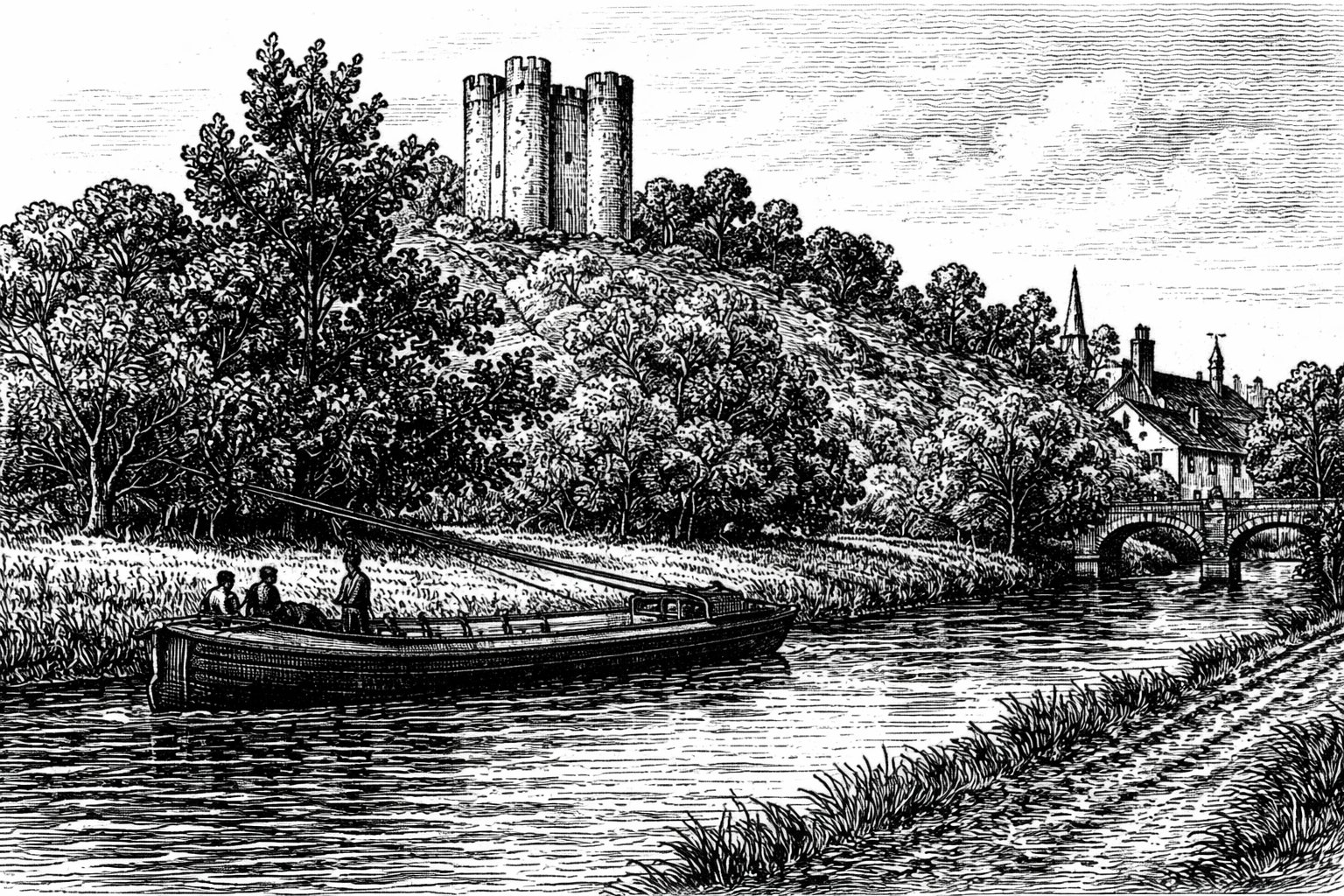
Conisborough Castle stands on an eminence thirteen miles to the east of Sheffield, and overlooks the valley of the Don. The castle was built in 1180 by Isabel, daughter and heiress of William de Warren, and wife of William de Blois, and afterwards of Hameline, Earl of Surrey.
Mr. E. Roberts, F.S.A., contributed the following history of the ruin to the Congress of the British Archaeological Association in 1873:—
“The height was probably a few feet higher than the loftiest existing stone, screened by a breastwork; the roof nearly flat; turrets on each buttress towering above the battlements, one probably loftier than the other for a beacon. Just below the parapet was a covered way, all round which communicated with the beacon tower and the second tower next it, both having winding stairs leading to the uppermost walk.
On this story there was an oven in which to prepare food for the garrison when the other parts of the castle had been captured. Oxford Castle, Suffolk, which Conisborough Castle resembles in several particulars, is the only other castle with such a position. It has been suggested that the ovens were for heating missiles, but this is improbable.
Of the other turrets, two have chambers for shelter and rest and for storage; the sixth and last turret having a much larger and loftier recess, with small outer apertures, probably for pigeons, which, with their eggs, were favourite articles of food. The stairs are within the thickness of the walls, and 3ft. 11in. wide, the inside wall being 3ft. 11in. and the outside wall 5ft. 5in., making 12ft. 5in. of thickness in all.
The staircase and gallery communicated with a central chamber, as is shown by the jamb of a doorway still remaining. Descending the stairs we arrive at what may be called a second story, where was a door; immediately on the right is a small recess in the wall, terminating in a latrine; a loophole, without glass, gave light and air to the place. The chamber was for residence, but of a mixed character; for though there is a very beautiful fireplace which modern architects might imitate with advantage (almost purely early English, and good enough for any lady’s drawing-room), there is a stone sink very near it.
An exquisite little chapel adjoins, in which are two piscinae, two quatrefoil lights, and an eastern loop. There is more of the Norman character about this chapel than in any other parts of the castle. Adjoining, and leading out of it, is the sacristy. The only light to the chamber on this floor was one window, approached by three steps, and with the usual luxury of window seats. On the descent there was a bar fastening outside the door, as if those above had to be treated as prisoners. The thickness of the walls and stairs is 13ft. 7in.
On the first floor is a magnificent fireplace, also a sink, another latrine, and another ‘ladies’ bower,’ or window, approached by four steps. Shutters once closed these windows, and a strong bar passed across; but they were guiltless of glass. On the centre mullion is a cushion, or roll, pierced both ways for the shutter bolts.
These windows, raised a few steps above the floor, served a double purpose. The keep was the lord’s private apartment and that of his lady and chief guests. The raised window was so made that in time of war it could be closed by shutters bolted and barred, and if an arrow found entrance from below, it fell harmlessly on the other side, as a bullet now would if discharged through a window in the ceiling.
In time of peace it was the ladies’ drawing-room seat—a gossiping place with a delightful look out from an open window. With mats or rushes on the floor, and cushions on wooden ledges laid on the stone seats, we might even now envy the charms which simplicity gave to the lives of those who looked on chivalry and chivalric deeds as the only gentlemanly exponents of breeding.
The ground story was lighted by the doorway only; below was the cellarge and the well which has recently been cleared. It is idle to call this the dungeon, as is usual; it was the place for stores of provisions. The barholes remain at the outer door. The outer steps, though perhaps all modern, are probably in the same place as the originals.
Externally we find what has been called a sallyport and postern gate, but may have been really a dungeon. The gateway, passing between walls for a considerable distance, is facing the village. The walls of the ballium are occasionally dotted with circular bastions, indicating, as well as the masonry, a later period than the keep. Outside there is a vallum, and again a ballium, nearly all of which is destroyed.”