
Mexborough & Swinton Times – Friday 01 January 1904
Wesleyan Bazaar at Conisboro’.
A Successful Effort.
The large room of the new schools at Conisboro’ presented a greatly changed appearance on Tuesday and the succeeding days, Wednesday and Thursday, owing to the fact that the Wesleyans had obtained permission from the School Board authorities to prepare the hall for a bazaar. Dainty stalls, all neatly trimmed with holly and Christmas decorations, were arranged round the spacious hall, whilst dotted about in the centre were others all heavily laden with useful goods, ornamental articles and other bric-a-brac dear to the feminine folk. The high bare walls, ordinarily covered with maps, modulator, etc., etc., were all covered from view with red, white, and blue bunting, Union Jacks, and varied coloured muslin, in addition to a profusion of holly and mistletoe, put a decidedly Christmas appearance on everything. All the stalls were wonderfully trimmed, the woodwork being completely hidden from view by the folds of yellow muslin entwined with ribbons, etc., which betokened that the lady members of the church must have been working hard in order to achieve such results.
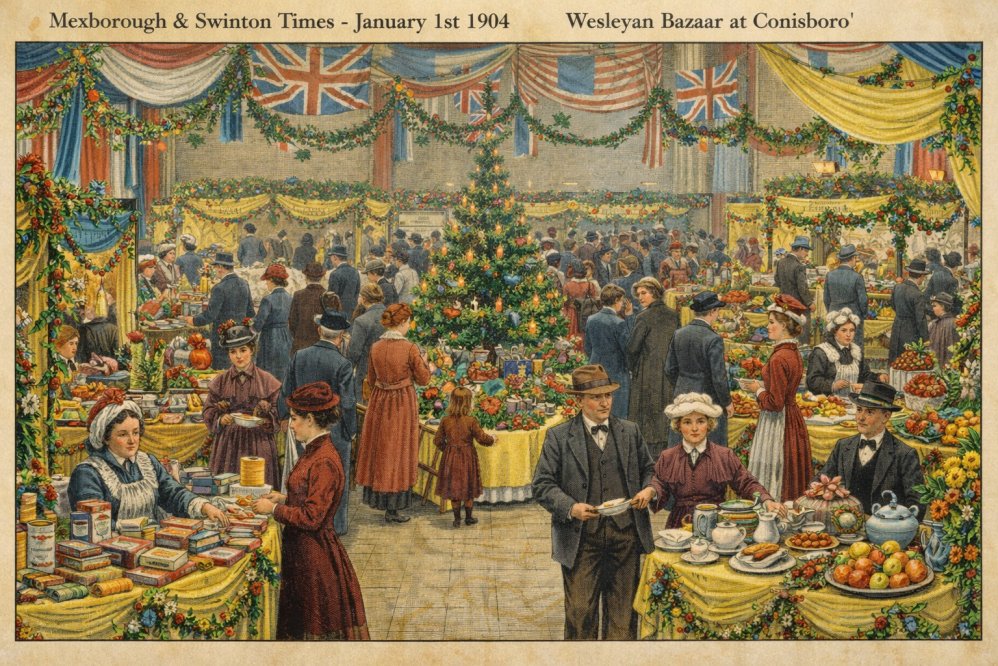
All this trouble that has been taken in order to make the bazaar to go has been in order to raise the sum of £500 towards the cost of erecting a suitable house for the resident minister, the Rev. J. Whincup. A site, it may be stated, has been acquired just below the Dale, at a cost of £160. This site was chosen really because of its central position; it will be within easy distance of the railway station, as the rev. gentleman has a lot of outside work to do, this will be a great boon to him. He will also be nearer the Denaby people, whilst the house will be better in every respect than the one he now occupies.
Although his present residence is very commodious, etc., yet it is not so central as the friends would wish, and this really is the whole reason of building a house of their own. The total cost is expected to be about £800, and Mr. H. L. Smethurst is the architect. The present Wesleyan Chapel was built in 1876, with a schoolroom attached, and with a very beautiful structure. All the officials and members are to be congratulated upon the splendid display they have made, and this fact is all the more emphasised when it is known that the whole of the work and everything in connection with the effort has been completed within two months. Since the idea was first mooted coupon books have been distributed and 6d. tickets sold, their value to be returned at the bazaar. Some families have obtained as much as 10s. worth of goods, and this, coming during Christmas, and especially with trade in such a state, will be very beneficial to many.
The friends have received very generous support from the local gentry. The officials are as follows:—Rev. T. H. Kirkness (Doncaster), Rev. J. Whincup (Conisboro’), circuit ministers; Mr. J. Brockleby, treasurer; Mr. H. L. Smethurst, Mr. J. Ward, and Mr. G. Brockleby, secretaries.
Previous to the opening ceremony on Tuesday a luncheon, given by Mrs. Caleb Kilner, and served by Mr. Oliver, of Doncaster, was held, to which about 100 persons sat down. There was a good company present when the opening took place.
The chair was taken by Mr. J. R. Kilner, of Thornhill Lees, and he was supported by Mr. Geo. William Kilner, of London, the Rev. T. H. Kirkness, Rev. Jos. Whincup, and the Rev. W. S. Maxey.
The Rev. J. Whincup, in introducing the chairman, said he was sure they were all interested in the welfare of the Methodist Church, and they all knew what an interest the family of Kilners took in the doings of their chapel. Mr. Kilner had not only come himself, but he had brought his own brother with him to open the bazaar. (Applause.)
The Rev. W. Maxey then read a portion of Scripture, after which
The Chairman, who was heartily greeted, said he was very pleased to be present that afternoon. He heartily congratulated the friends upon the very excellent show they were making, as he noticed, at ordinary times the school walls would be very bare. They had all evidently been working very hard, and he was pleased they had got a good show for their labours. (Hear, hear.) He sincerely hoped that before Thursday night that the walls would be bare again—(applause)—and everything sold. Speaking about the Methodist Church, he need not comment upon the fact that it commanded a very great place in the country. As Methodists they had still work to do, and, as Methodists, they, of course, thought they could do it only in the right way. (Hear, hear.) They, as individuals, had a right to do their own share. The Rev. J. Whincup said he was pleased to present a list of subscribers and amounts:—Mr. Hy. Wilson, Doncaster, £5 5s.; Mr. Fred Kilner, London, £3 3s.; Mr. John Baker, Rotherham, £2 2s.; Mr. F. W. Ireson, M.P., £2 2s.; Mrs. Knowles, Thornhill Lees, £2; Dr. James Foster, Conisboro’, £1 1s.; Miss Roberts, Sheffield, £1 1s.; Mrs. William Kilner, London, £1; Mr. H. Baker, Conisboro’, 10s. 6d.; Mrs. Woodyeare, Crookhill Hall, 10s.; making a total of £18 4s. 6d. (Applause.)
Mr. George W. Kilner, who opened the bazaar, was loudly applauded on rising, said he wanted to enter a word or two of protest as regarded his presence there that afternoon. (Laughter.) When his father was alive he was Mr. Kilner’s son, later on he was their chairman’s brother, whilst to-day the chairman was referred to as having brought his brother with him. (Loud laughter.) He would try and bear with them under the circumstances. He was very pleased to be amongst them once again. One thing he was pleased he came for was because he had seen the sun that day, the first time for many weeks; that was a great pleasure in itself on a winter’s day. He had been travelling backwards and forwards to London and Conisboro’ for the past thirty years, and this was the first time he had really spoken at a gathering of that description. He was fortunate enough to be in that position thirty years hence he would find that a great number of changes had taken place. With reference to the object of the bazaar, they ought all to do the best they possibly could, as the chairman indicated. He noticed that the object of the bazaar was the provision of a minister’s house. He thought it was a very good object too, ministers must have houses as well as other people, and it was their duty to make them as comfortable as possible. Methodism depended to some extent on its ministers, therefore, it was their duty, as far as it lay in their power, to make them comfortable and they expected in return the best they could give to them. (Hear, hear.) There was a great cry for more proficient ministers, and in one quarter there was talk of lengthening the term of service and Theological tuition. Methodism had a great part to play in this country’s history; he did not wish them to misunderstand him, he expected others would have a look in. Methodism was a ministry, and they, as members, were all called upon to take part in that ministry; they, as Christians, were called upon to take part in the evangelisation of the world. (Applause.) As to the bazaar itself, he must highly congratulate them all for the very excellent display. During the three days he hoped they would have sold all the things displayed. He wished them every success, and formally declared the bazaar open. (Loud applause.)
Mr. B. J. Clarkson moved a vote of thanks to the chairman, and Mr. G. W. Kilner, and all who had in any way helped towards the bazaar. He was sure the object was a good one. When all the debts of the house were paid off they would be able to save £30 a year.
Mr. Watson, junr., circuit steward, seconded. The name of Kilner was a household word in Conisboro’, and throughout the length and breadth of Methodism.
The Rev. J. Whincup said he had a further list of subscriptions to hand including Mr. G. W. Watson, £10; Mr. J. R. Kilner, £5; Mr. James Wilson, 10s.; making a total of £34 4s. 6d. (Loud applause.)
THE SECOND DAY.
At the opening ceremony on Wednesday the chair was taken by Mr. Caleb Kilner, whilst there were present Mr. C. N. Nicholson, Rev. J. Whincup, Mr. J. Brocklesby, Mr. W. Wilson, and other gentlemen.
The Rev. J. Whincup did not think Mr. Kilner would require any introduction. He was a very old friend of theirs, a constant friend, and not a spasmodic one. (Hear, hear, and applause.) They knew he took a great interest in their church at Conisboro’, and he wanted them to give him a right hearty welcome.
Mr. Kilner, on rising, was greeted most cordially. He first called upon Mr. Brocklesby to read the financial statement. The total proceeds of the previous day were £108 5s. (Loud applause.) He thought that was a very satisfactory return for the first day’s proceedings.
The Chairman said he must first of all congratulate the ladies upon the great success of the previous day. (Hear, hear.) They required a minister’s house; that had been dinged into his ears for the last two months at home. He had always taken an interest in Methodism in Conisboro’, and in the Oxford Place circuit and in the welfare of Conisboro’ generally. He was glad that the bazaar had proved so successful so far, and he hoped it would be continued. (Hear, hear, and applause.)—Mr. C. N. Nicholson said it gave him very great pleasure to come down to try and assist the bazaar, which was for such a worthy object. Bazaars were held chiefly for the raising of money, and some were held sometimes for what he would call indiscriminate charity. They, however, had a most deserving cause, and he heartily congratulated them upon the success they had met with up to the present. A resident minister was very necessary. The speaker also referred to the very energetic crusade that was being carried on in the Potteries against the vices of the people. He hoped they were not as bad as that at Conisboro’, but much energetic work needed to be done. Before he came to Doncaster he worked in one of the most crowded districts in London, and every day he used to pass the old house where John Wesley used to live, and his old chapel, where he used to worship. The old buildings were kept in the most careful repair, as a memorial to the great man. His name was inscribed over the door, whilst quite recently a statue had been erected. From what he had seen there was any amount of energy in Wesleyan Methodism in this district. Education in this country was becoming more and more secular, and the more secular it became it was all the more necessary to have their Sunday schools in thorough working order.
Mr. Brocklesby moved a vote of thanks to Mr. Nicholson and Mr. Kilner, which was seconded by Mr. Wilson and carried.
The stallholders were as follows:—Conisboro’ Sewing Meeting stall: Mesdames Bates, Taylor, T. Booth, Earnshaw Everatt, B. J. Clarkson, Brocklesby Wallace, and Miss Goodlad. Fancy stall: Mrs. Ward, Miss Bates, Mrs. W. Maxfield, Miss Greenough, and Miss Sellars. Sunday School stall: Mrs. Geo. Appleyard, Mrs. Tom Pagdin, Mrs. Jno. Bagley, Miss Marlborough, the Misses Gurrey, Misses Button, Flint, Sargentson, Bennett, Miss Mary Laughton, Mr. Fred Hawksworth, Mr. Oswald, Mr. Chas. Oswald, Mr. Bagley, Mr. Bennett, Mr. George Gurrey, Mr. Herbert Downing, and Mr. Ernest Downing. Refreshment stall: Mrs. Meggitt, Mrs. Sargentson, Mrs. Rodda, Mrs. J. Stenton, Mrs. W. Wilson, Mrs. W. Appleyard, Mrs. G. Appleyard, Mrs. Blackburn, Mrs. Platts, and Mrs. Frank Senior. Fruit, plant, and flower stall and Christmas-tree: Mrs. Smith, Misses Wilcock, Leonard, F. Sellars, Mary Laughton, J. Booth, Wright, Wilson, Pagdin, Piper, M. Wilson, Clarkson, Turnbull, Backburn, and M. Greaves. Denaby Main stall: Mrs. George Kilner, Mrs. H. H. Wray, Mrs. Jarman, Mrs. Wilson, Mrs. J. Senior, Mrs. H. Wilson, Miss Astbury, Mrs. Foulston, Mrs. Geo. Latuson, and Miss Bateson. Circuit stall: Mrs. Kirkness, Mrs. Raithby, Mrs. Moate, Mrs. H. Smith, Misses Wood, Beck, Clarkson, Mrs. Wagstaff, Mrs. Herbert, Mrs. Carr, the Misses Willow, Mrs. Wigglesworth, Miss Wilson, Miss Pearson, the Misses Richardson, Miss Eva Savton, Miss Middleton, the Misses Battye, Miss Green, and Miss Laughton. Sweet and toy stall: Misses Earnshaw, L. Ellis, Gladys Drabble, Ellis, Grace Maxfield, Doris Clarkson, and Connie Appleyard. Crockery stall: Mr. Wm. Appleyard, Mr. H. H. Wray, Mr. Turnbull, Rev. J. Whincup, Mr. Smethurst, Mrs. Smethurst, Mr. H. Appleyard, and Mrs. Rawding. Bran-tub and fish-pond: Miss Miriam Stenton, Miss Annie Everatt, Miss Lizzie Leyill, Master J. Whincup, Mr. Guy Clarkson, Master George Ward, Mr. Philip Brocklesby, Mr. Bosan Clarkson, and Mr. Harold Brocklesby. Weighing-machine: Messrs. R. Everatt and Booth. Parcels office and cloak-room: Mr. J. H. Brocklesby and Mr. R. Wilson. Gentlemen’s and advertisement stall: Messrs. J. Brocklesby, Geo. B. Appleyard, Tom Pagdin, Earnshaw, B. J. Clarkson, W. Farnery, F. Appleyard, T. R. Sellars, and J. Ryan.
The musical arrangements for the first day were in the hands of Mr. and Miss Burgess, and on Wednesday and Thursday Mr. J. K. Bateson and Mr. W. H. Wilson. In the evening there were competitions, potato peeling, nail-driving for ladies, stocking darning for gentlemen, and spelling. Exhibition of curios: Mr. George Marlborough, Mr. Geo. Brocklesby, and Mr. Wm. Ellis.